Fuel Monitoring — For the Largest Line on Your P&L and the Only One That’s Currently an Estimate
Every fleet, farm, site, and genset estate in Kenya runs on the same accounting fiction: fuel is bought in verified litres and consumed in estimated ones, and the gap between those two numbers is somebody’s income. Kendaall’s fuel monitoring service closes the gap with instrumentation — calibrated tank sensors on vehicles, machines, generators, and bulk storage, logging level continuously at ±1-litre resolution, verifying every fill against its receipt, alarming every drain as it happens, and benchmarking what each asset should burn so the ones that don’t stand out by themselves.
Get a Fuel Monitoring Quote See Fuel Sensors
A Fuel Gauge Tells the Driver Roughly How Far. A Fuel Sensor Tells the Owner Exactly What Happened.
Fuel monitoring is the conversion of a tank from a rumor into a record. The gauge on the dashboard was engineered for one question — “do I need a station soon?” — and answers it to the nearest eighth of a tank, for the person driving. It has nothing to say to the person paying: not how many litres yesterday’s fill actually delivered, not whether the level dropped forty litres at 2 a.m. while parked, not whether this truck burns three litres per hundred kilometres more than its identical twin, and not whether the month’s fuel spend matches the month’s work done. Every fuel control system built on gauges, receipts, and driver declarations inherits those blind spots — which is why fuel loss in unmonitored operations across the region persistently runs at 10–20% of throughput, priced permanently into budgets as if it were physics.
Kendaall’s fuel monitoring replaces the declaration chain with a measurement chain. A capacitive sensor, fitted into the tank and calibrated against measured fills for that specific tank’s geometry, streams level readings continuously through the same device that powers the asset’s GPS tracking — so every litre-event carries a time, a place, and a vehicle state. The platform then reads the curve: a fill is a rise, verified in litres against the receipt or the bowser docket; consumption is a slope, benchmarked per kilometre, per engine hour, or per job; and theft is a cliff — a stationary, engine-off drop that raises an alarm while the siphon hose is still in the tank. The same instrumentation extends beyond wheels: excavators and graders burning by the hour, generators at remote sites, tractors refuelled from farm drums, and the bulk storage tanks that feed them all — closing the loop from delivery truck to burn.
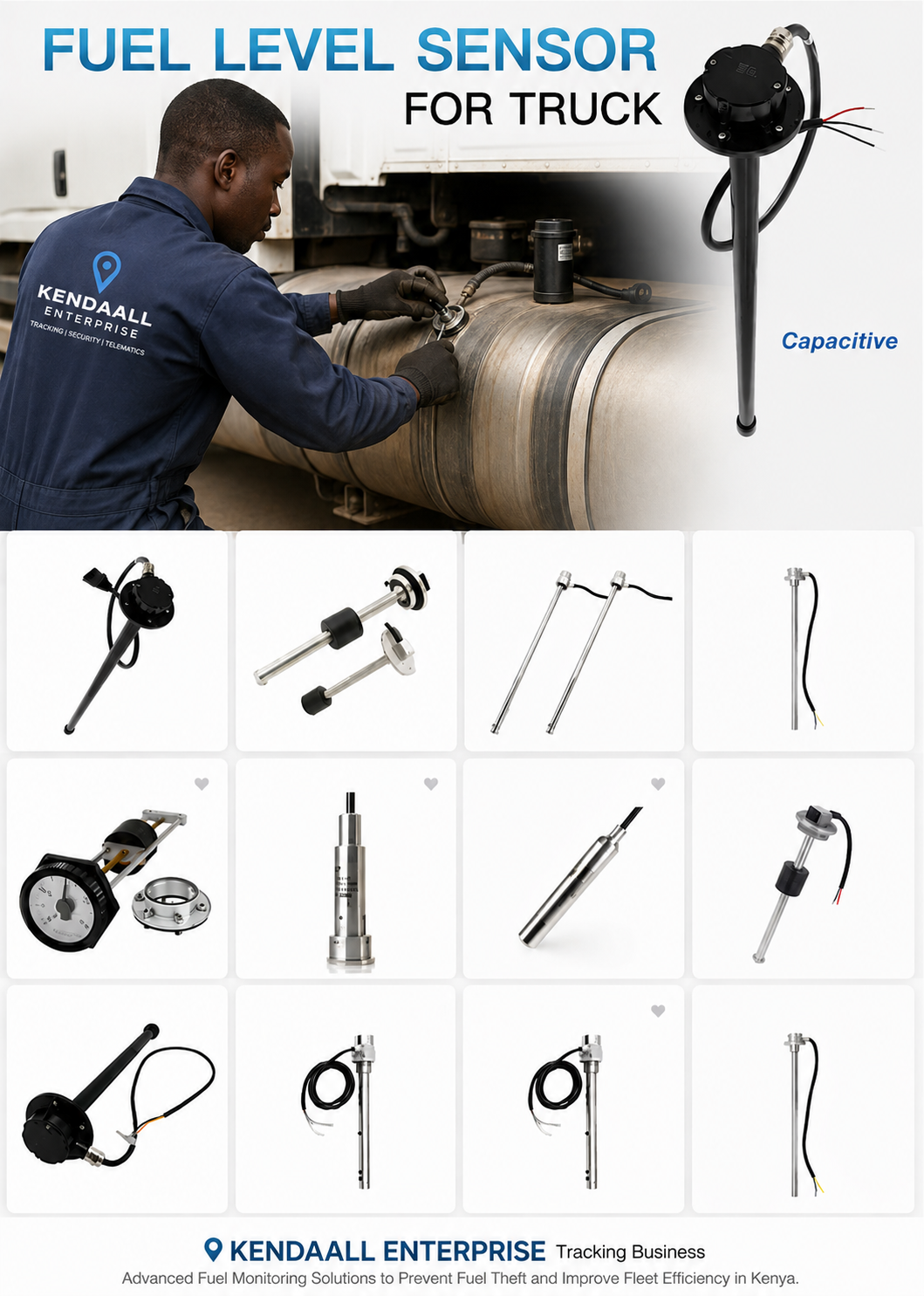
Calibration against measured fills is what separates a fuel sensor from a fuel opinion.
The commercial case rarely needs selling twice, because fuel is the one cost line where monitoring pays back in weeks rather than quarters. For a logistics operator, fuel is 30–40% of operating cost; for a working excavator or a telecom genset estate, it is the dominant cost outright — and a recoverable 10–20% of a dominant cost is, in most businesses we instrument, the difference between the margin they have and the margin they thought they had. The service deploys across the entire Kendaall platform: logistics fleets on the corridors, PSV and bus operators, corporate fleets reconciling fuel cards, sites, farms, and estates — with every asset’s fuel data landing beside its location, hours, and driver behaviour in one fleet management account.
Six Ways Fuel Leaves Without Working — and How the Curve Catches Each One
Classic Siphoning: the Overnight Drain
Parked truck, quiet yard, forty litres into jerricans before dawn — the oldest trade in the fleet economy, sustained entirely by the fact that nobody measures a parked tank. On the curve it is unmistakable: a stationary, ignition-off cliff, alarmed in real time with the litres, the time, and the GPS position attached. The first alarm usually ends the practice fleet-wide; word of instrumented tanks travels faster than any memo.
The Short Delivery
Three hundred litres invoiced, two hundred and forty delivered — short drops at the pump, the bowser, and the farm drum are the supplier-side half of fuel loss, and receipts can’t catch what receipts themselves certify. The sensor’s fill-event record settles it: the tank rose by what the tank rose by, and the delta against the invoice is a number you can put in an email. Clients report supplier behaviour correcting within two or three audited deliveries.
Fuel Card and Receipt Games
Fuel drawn on the company card into a private car, receipts for fills that never entered the tank, the “full tank” claim on a vehicle that took twenty litres — paperwork fraud thrives where paper is the only witness. Cross-referencing card transactions and receipts against sensor-recorded fill events, litre for litre and timestamp for timestamp, turns reconciliation from an act of faith into a five-minute report — the control our corporate fleet clients cite most in audits.
Idle Burn: Consumption With No Kilometres
Engines idling through lunch, aircon running for the queue, machines warming far past need — fuel that was genuinely burned, for nothing. Because fuel data lands beside ignition state and movement, the platform separates working burn from idle burn per asset and per driver, and prices the idle in shillings per month. It is the gentlest fuel saving on this list — no accusation required, just a number on a noticeboard — and often the largest.
The Thirsty Twin: Consumption Drift as an Engine Symptom
Two identical trucks on identical routes should burn identically; when one drifts three litres per hundred kilometres high, the fuel curve is diagnosing something — injectors, filters, tyre pressure, a driver’s right foot — months before the workshop would. Consumption benchmarking per asset class turns the fuel system into an early-warning layer for predictive maintenance, catching the expensive repair while it’s still a cheap one.
No Baseline, No Budget, No Argument
The quietest cost of unmeasured fuel is that every dispute is unwinnable: the driver’s allowance claim, the operator’s per-acre estimate, the tender priced on guesswork. Within weeks of instrumentation, every asset has a true consumption baseline — per kilometre, per hour, per tonne, per acre — and everything built on fuel numbers (allowances, quotes, budgets, hire rates) suddenly stands on measurement. Several clients tell us the baseline, not the theft alarms, repaid the system.
Five Modules From the Tank to the Balance Sheet
MODULE 01 · Calibrated Tank Sensing
The foundation everything rests on: a capacitive sensor fitted into the tank and calibrated against measured fills for that tank’s specific geometry — because tanks are irregular shapes and an uncalibrated sensor is a confident liar. Fitting and calibration are performed by the installation team to a documented procedure (60–90 minutes per tank), with recalibration available through the repair & maintenance service whenever tanks are replaced or readings drift.
- Capacitive sensors sized to tank depth, cut and sealed on-site
- Multi-point calibration against measured fills, documented
- Dual-tank and bulk-tank configurations for trucks and storage
- ±1-litre practical resolution, continuous logging
MODULE 02 · Fill & Delivery Verification
Every rise in the curve becomes a fill event: litres gained, station or site location, time, and the vehicle’s odometer or hour reading at that moment — automatically matched against fuel card transactions, receipts, or bowser dockets where you feed them in. Short deliveries, phantom fills, and off-route fuelling surface as line-item exceptions rather than month-end suspicions.
- Automatic fill detection with litres, location, and time
- Receipt and fuel-card cross-referencing, exception-flagged
- Bulk delivery verification for farm, site, and estate tanks
- Off-route and off-schedule fuelling alerts
MODULE 03 · Theft & Drain Alarms
The module that pays first: any abnormal drop — stationary, engine off, or faster than the engine could burn — raises an immediate alarm by app and SMS with litres lost, position, and time, escalating through whatever chain you define (driver, yard manager, owner, response team). Slow-drip theft over long hires and multi-day drains at remote sites are caught by rate analysis rather than single events, so patience doesn’t beat the system either.
- Real-time stationary-drop alarms with litres and location
- Rate-analysis detection of slow and repeated draws
- Escalation chains configurable per asset and site
- Event evidence packs for disciplinary and police processes
MODULE 04 · Consumption Analytics & Benchmarking
Fuel data joined to distance, hours, and work: litres per hundred kilometres for vehicles, per engine hour for plant and gensets, per acre for farm work — benchmarked within asset classes so outliers surface automatically. Idle-burn reports price the parked engine per driver and site; consumption-drift alerts feed the maintenance desk; and monthly fuel statements per asset, route, and department land in the formats finance actually uses.
- Per-km, per-hour, per-job consumption baselines by asset class
- Idle-burn costing per driver, vehicle, and site
- Drift alerts as an engine-health early-warning layer
- Finance-ready monthly statements and Excel exports
MODULE 05 · Whole-Chain Reconciliation: Storage to Burn
For operations running their own storage — farm tanks, site bowsers, depot pumps, genset day tanks — sensors on the bulk side complete the audit loop: litres delivered into storage, litres issued out, litres arriving in each asset’s tank, litres burned doing work. The four numbers must agree; where they don’t, the gap has a time, a place, and a shortlist. This is the module that turns fuel from a cost centre with a leak into a supply chain with a ledger.
- Bulk tank monitoring with delivery and issue events
- Issue-to-asset matching: what left storage vs what arrived in tanks
- Estate-wide reconciliation reports across sites
- Variance alerts with per-transaction drill-down
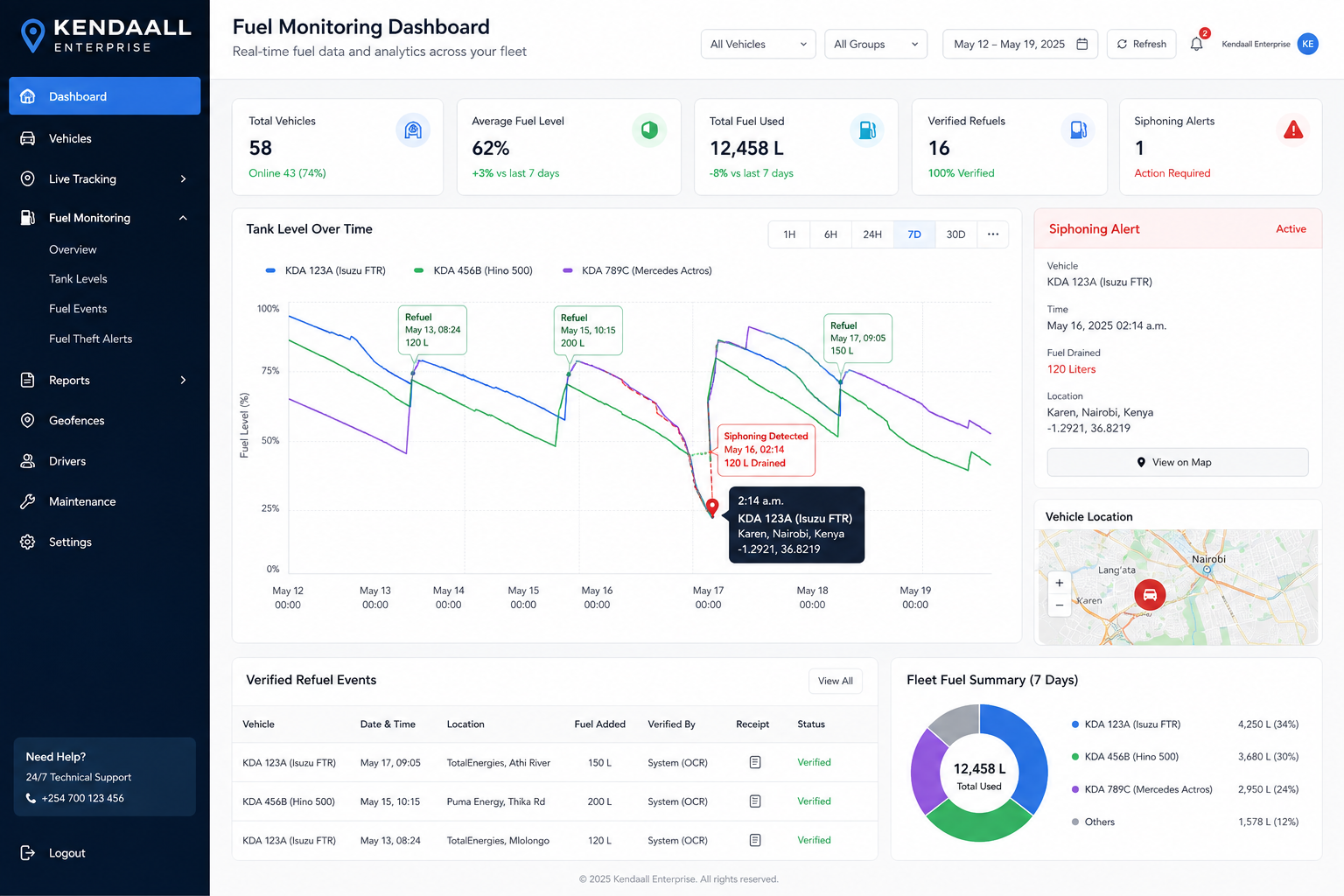
The curve tells the whole story: fills verified, burn benchmarked, and one cliff at 2:14 a.m. with a position attached.
One Measurement Chain, Every Kind of Tank
Trucks & Logistics Fleets
Corridor fleets where fuel is a third of operating cost: dual-tank sensing, en-route fill verification, and per-route consumption baselines for honest job costing. See logistics fleet tracking.
Buses, PSVs & SACCOs
Daily-fuelled fleets where small per-vehicle leaks compound across the livery — allowance reconciliation and per-vehicle baselines for PSV operators and SACCO fleets.
Corporate & NGO Fleets
Fuel-card estates with audit obligations: transaction-to-tank cross-referencing, private-use exposure, and the monthly statement finance signs off without a meeting.
Construction & Plant
The highest burn rates and the highest theft exposure in one place — machine tanks, site bowsers, and the reconciliation between them, alongside hour metering.
Farms & Agriculture
Drum-and-jerrican economies converted to curves: storage tanks, tractor tanks, and burn-per-acre baselines on the agriculture platform.
Generators & Static Estates
Telecom sites, boreholes, institutions — day tanks and bulk tanks on continuous watch, with runtime attribution per litre on the generator platform.
What Operators Ask Before Instrumenting Their Tanks
How accurate is the sensor really — can it tell 5 litres from a gauge wobble?
Yes, and the distinction matters. Calibrated capacitive sensing resolves to roughly a litre under normal conditions, and the platform’s filtering separates real level changes from slosh, gradients, and temperature drift — so a five-litre draw on a parked vehicle registers as an event, not noise. The honest caveat: accuracy is a product of calibration, which is why we calibrate every tank against measured fills at installation and recalibrate whenever readings drift or tanks change. An uncalibrated sensor is worse than none; ours don’t ship uncalibrated.
Can drivers or site staff defeat the sensor?
The known tricks are designed against: the sensor and its wiring are sealed and tamper-flagged, disconnection raises an immediate alert, and theft methods that avoid the sensor entirely — draining from the fuel line, short-filling at the pump — still appear in the data, because the curve reconciles what entered against what the engine could have burned. The pattern we see in practice is short-lived experimentation followed by fleet-wide behaviour change; the sensor’s deterrent value outlasts its detection value.
Does fuel monitoring require your tracking system, or can it run alone?
The sensor reports through a Kendaall telematics unit, so an asset needs one on board — but that’s the pairing that makes the data meaningful, since every fuel event then carries position, ignition state, and distance or hours. Assets already on our platform add the sensor as a plug-in upgrade; new assets get both in one installation visit; and fleets on other providers can migrate via a takeover audit from the repair team.
What does the payback actually look like?
Three layers, in the order they usually land: the deterrent effect (consumption drops measurably in the first weeks once tanks are known to be watched), the caught events (verified short deliveries and siphoning with evidence attached), and the baseline effect (allowances, quotes, and budgets re-priced on true numbers). On assets moving meaningful fuel — trucks, plant, gensets — the sensor typically covers its own cost within one to two months; the pricing page has per-asset figures, and the quote form will model it against your actual monthly fuel spend.
We suspect a specific person. Will the system prove it?
What the system provides is events with evidence: litres, timestamps, locations, and the asset’s state — the factual layer on which a fair process can stand. It won’t name a culprit, and we’d counsel against treating any single alarm as a verdict; patterns across events are stronger and fairer. Most clients find the outcome they actually wanted wasn’t a prosecution but a fleet where the losses simply stop — which is, reliably, what instrumented tanks produce.
Can it monitor petrol vehicles and small tanks, or only diesel trucks?
Both. Sensors are sized to tank depth and work in petrol and diesel alike; small tanks — pickups, vans, even motorcycle fleets in courier use — are served either by tank sensors where geometry allows or by consumption analytics from fill-event tracking where it doesn’t. The right configuration per asset class is part of the site survey; describe the fleet in your quote request and we’ll specify honestly, including where a sensor isn’t worth its cost.
Your Fuel Bill Already Knows the Truth. Put a Sensor Where It Can Say It.
Send us the fleet or estate — assets, tanks, and roughly what you spend on fuel monthly — and we’ll return a sensor configuration, per-asset pricing, and a payback estimate against your own numbers.
Request a Fuel Monitoring Quote Talk to a Fuel Specialist