Tractor Tracking & Agriculture GPS Tracking in Kenya: Acres, Hours, Litres and Operators, Measured From the Machine
A mechanised farm runs on numbers that the people who spend the money also supply: the acres an operator says were ploughed, the diesel a caretaker says was drawn, the hours a dash meter says the engine ran. Kendaall’s agriculture tracking platform replaces each of those declarations with a measurement taken from the machine itself — a GPS coverage map of the field, an acreage figure derived from the track and the implement width, calibrated fuel-level readings from the tank, ignition-wired engine hours, and a named operator attached to every session. It is fitted on tractors, combine harvesters, sprayers, trailers and implements across Kenya’s grain belt, sugar zones, horticulture estates and ranching country, and it answers the one question every owner eventually asks: what did the machine actually do while nobody was standing in the field watching it?
Get a Farm Fleet Quote Book On-Farm Installation
On a Road You Track Where a Vehicle Went. On a Farm You Track What the Machine Did.
Agricultural tracking is work verification before it is location. A delivery truck’s day is a route between two points; a tractor’s day is a pattern — passes up and down a block, an implement in the soil at a working depth, a job that either got done to specification or did not. Standard GPS vehicle tracking answers “the tractor was in Block C from 07:00 to 11:00” and stops there. Tractor tracking reads the pattern underneath that timestamp: the coverage map of the block, the acreage worked calculated from the passes and the registered implement width, the working speed that separates real primary tillage from a machine driven fast over the surface, the hours the engine genuinely ran against the hours written in a logbook, and the litres that moved through the tank while all of it happened.
That distinction is the whole economics of mechanised farming in Kenya. Farm machinery operates in the least supervised environment of any asset class we instrument — further from the owner than a matatu on a city route, less witnessed than a construction machine on a fenced site, and embedded in a reporting culture where acres, hours and diesel are all self-declared by the people who consume them. Contract work compounds it. An operator paid per acre has an incentive to widen the claim; a smallholder or medium-scale farmer hiring a tractor per acre has no independent measure of what was bought. The platform gives both sides the same neutral number, measured from the machine, and turns diesel — the largest recurring cash line on a mechanised farm — from a handwritten ledger into a continuous curve using the same calibrated fuel sensors deployed on every fuel monitoring installation we run elsewhere: every fill verified, every drop alarmed.
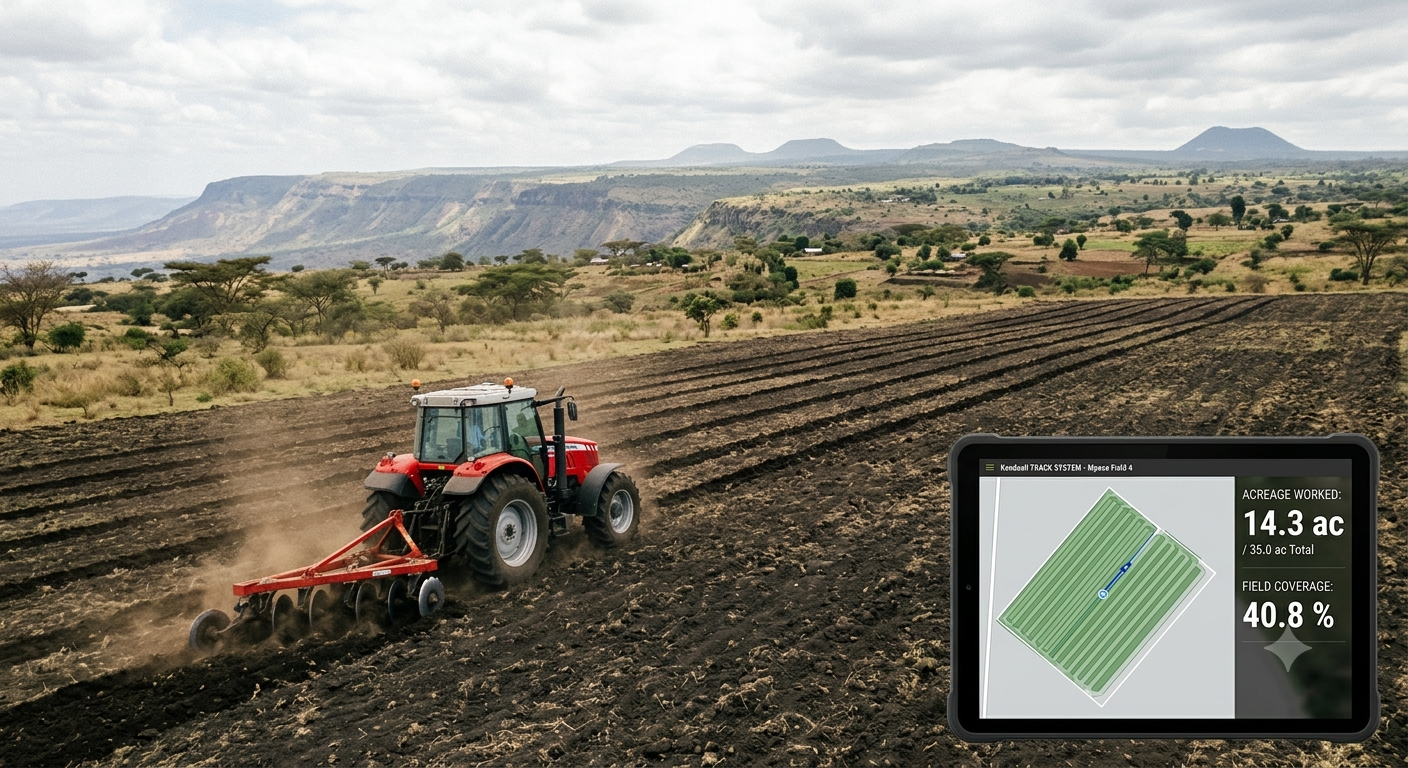
The coverage map does not estimate the job — it draws it, pass by pass.
Proxy Measurements and Direct Measurements
The word “measurement” gets used loosely across the tracking industry, so it is worth being exact about what changes when a machine is instrumented. A dash-mounted hour meter measures ignition-on time, which is not productive working time: a tractor idling at the headland waiting for a trailer accumulates hours identically to one pulling a four-furrow plough through hard ground. A verbal acreage report measures an operator’s confidence in their own estimate, which correlates loosely with the block actually covered, particularly on irregular plots with headland turns, rock outcrops, dams, tree lines or a contested boundary with a neighbour. A fuel-drum tally measures what was poured out of the drum, not what reached the tank rather than a jerrican in the back of somebody’s car.
In each case the platform substitutes a direct measurement for the proxy. GPS track plus implement width replaces the verbal estimate. Ignition plus movement plus speed replaces ignition alone. Calibrated capacitive or ultrasonic level sensing inside the tank replaces the tally sheet. The gap between the proxy and the direct measurement is, on nearly every farm we have instrumented, wider than the owner expected — and closing that gap is the product, more than the hardware that makes it possible.
It also explains why agriculture is treated as its own instrumented category rather than a variant of road-fleet tracking. A saloon car or a delivery van moves point to point along a road network that satellite positioning was originally built to describe. A tractor moves back and forth across an irregular polygon that has to be defined, block by block, before coverage can be calculated at all. Agricultural tracking therefore begins with a mapping step — capturing the boundary of Block C — that road-fleet tracking never requires, and every acreage figure the platform produces is downstream of that step.
Where the Platform Is Fitted
Installation happens on the farm; machines never travel for fitting. Coverage runs countrywide, with the heaviest concentration across the maize and wheat belts around Eldoret and Uasin Gishu, Trans Nzoia around Kitale, the wheat and barley plains of Narok and Timau, the mixed farming districts of Nakuru, the flower and horticulture estates around Naivasha, the sugarcane zones of Bungoma, Kakamega, Kisumu and Kwale, the tea estates of Kericho and Nandi Hills, the rice schemes at Mwea, and the ranches and conservancies of Laikipia, Nanyuki and Machakos. Kenya’s agricultural policy institutions have pushed mechanisation as a productivity priority for years; the Ministry of Agriculture and Livestock Development tracks tractor density and hire-service access as standing indicators of farm modernisation. The same forces that make mechanisation valuable — fewer labour hours, more consistent seedbed preparation, shorter planting and harvest windows — are exactly what make an unmonitored machine an expensive blind spot when it underperforms, idles or disappears.
Nine Things a Tracked Farm Machine Is Connected To
A working farm is a set of relationships, not a set of features. The tractor has an operator. The operator works a block. The block sits inside a boundary. The engine burns diesel drawn from a tank that is filled from farm storage. The runtime accumulates against a service interval. The season decides whether a moving machine is productive or stolen. Everything the platform measures is one of those connections made visible, and each has its own attributes, its own failure mode and its own instrument.
The Tractor and the Farm Machine
AssetEngine-hour sourceFuel consumerGPS-tracked objectThe machine is the anchor. Its attributes are make and model, engine power, tank shape and capacity, transmission type, ownership status, purchase hours and current lifetime hours. A tractor in the 60–120 hp band doing primary tillage, a combine harvester working a three-week window, a self-propelled sprayer on a flower farm and a telehandler in a grain store are all the same entity type to the platform, differing only in duty cycle and in which sensors are worth fitting.
The Implement
Working widthAcreage multiplierTheft targetThe implement converts a GPS line into an area. A three-furrow mouldboard plough, a 24-disc offset harrow, a subsoiler, a four-row planter, a boom sprayer and a baler each carry a working width that the platform uses to compute covered hectares and acres from the machine’s track. Implements are also the most commonly stolen items on a farm, which is why they carry their own long-life magnetic asset trackers rather than relying on the tractor’s unit.
The Field Block
PolygonCrop historyJob attributionA block is a named polygon with a measured area, a crop, and a sequence of operations across the season. Once it exists in the system, every session inside it is attributed automatically — the operator selects nothing, and the season log for Block C accumulates by itself: ploughed 14 March, harrowed 22 March, planted 2 April, sprayed 28 April, harvested 11 August.
GPS Work Verification
Position streamCoverage mapPrecision agricultureThe link between machine and block is a position stream from the Global Positioning System, logged densely enough to resolve individual passes. Rendered against the block polygon it becomes a coverage map with visible gaps and overlaps — the data layer that the agronomy discipline of precision agriculture treats as its starting point for managing field-level variability instead of averaging a whole farm.
The Operator
IdentityRFID / BluetoothBehaviour recordA machine carries no accountability until a name is attached to each session. Identification hardware uses RFID tags or Bluetooth tokens to convert an anonymous ignition event into an attributed one, so hours, litres, speed, harsh use and coverage all belong to a person rather than to a shift.
Fuel
LitresBulk storageBurn rateDiesel exists in three places on a farm: the delivery, the bulk tank or drum, and the machine tank. Instrumenting the last two closes the chain, converting fuel from an estimated cost per acre into a measured litre count with a time, a machine and a position attached to every movement in or out.
Engine Hours
True runtimeIdle shareService clockHours are the currency of machine life: service intervals, warranty terms, resale value and hire billing are all denominated in them. The tracker meters them from its own ignition wiring and splits them into working hours and idle hours, so a 1,000-hour year can be read as what it really was — perhaps 720 hours of work and 280 hours of engine running while nothing moved.
The Boundary
GeofenceParking zoneAlert ruleField edges, farm perimeters, client land, workshop yards and machinery sheds are all expressed as a geofence with a schedule attached. Crossing one inside working hours is information; crossing the same line at 02:00 in February is an alarm.
The Season
Time contextRisk profileMaintenance calendarThe season reinterprets every other relationship. A position logged in the long rains describes land preparation; the same position logged in the dry months describes an asset that should not be moving. The platform does not change between them — the question being asked of it does.
Owners do not wake up wanting GPS in the abstract. They want to know whether the fuel bill matches the work done, whether the tractor was where it should have been last night, and whether the combine will still be running in week three of harvest. Each of those is a question about a relationship between two of the entities above — fuel and work, machine and boundary, engine hours and service interval — and the modules below follow that logic one connection at a time.
Six Leaks in Mechanised Farming — and the Instrument That Closes Each
Each problem below is a broken connection between two entities: the machine and the block (acreage), the machine and the tank (fuel), the machine and the calendar (moonlighting), the machine and the operator (shared-use blame), the machine and the workshop (maintenance timing), and the machine and the season (theft exposure). Naming the connection, not just the symptom, is what makes the fix legible.
Acres Claimed Against Acres Worked
Per-acre pay and per-acre hire both run on a figure nobody measures. The platform measures it directly: GPS passes plus registered implement width produce the acreage actually covered, drawn on the real block, so an operator claiming 25 acres against a map showing 17 has a conversation rather than a dispute. Contract ploughing businesses use the same maps in the other direction — proof of work attached to every client invoice, ending the “you missed my corner” argument with a picture instead of an assertion. Even where no per-acre pay structure exists, the coverage map answers a question owners otherwise cannot check: did the whole block get worked, or did the far corner get skipped because the turn was awkward and the ground was wet?
The Farm Fuel Economy
Farm diesel leaks through every joint in the chain: bulk storage with no meter, fills recorded in an exercise book, tractors refuelled in the field from jerricans, and consumption estimated per acre rather than measured per litre. Level sensors on machine tanks and on the farm’s storage tank replace the book with a curve — deliveries verified in litres against the supplier’s note, burn benchmarked by job type, and stationary drops alarmed with time and position attached. Because the sensor reads continuously rather than only at a fill, it also catches the slow pattern a monthly reconciliation never surfaces: twenty litres siphoned on each of eight nights, which no delivery-note audit would ever isolate.
The Weekend Tractor Business You Do Not Own
A tractor is a cash machine in any farming district, and an unmonitored one moonlights on the owner’s diesel and the owner’s wear: neighbours’ ploughing on the side, transport jobs on Sundays, hours that only ever surface later as an early engine overhaul nobody can explain. After-hours ignition alerts, farm-boundary geofences and operator identification put every run on the record the moment it starts. Owners rarely need to catch the same pattern twice — one alert with a timestamp, a position off the farm boundary and an unauthorised tag attached tends to end the practice before it becomes an argument.
Shared Machines, Shared Blame
Three operators, one tractor, and a burnt clutch that was always the other shift’s fault. RFID or Bluetooth operator identification means the machine itself knows who is driving: no tag, no start, and every session — hours, speed, harsh use, fuel, acres — attributed to a named person rather than a shift. Cooperatives and machine-sharing groups get the same engine pointed at governance instead: usage logged per member, so the ledger the treasurer works from is generated by the machine rather than reconstructed from memory a week after the fact.
Service by Season Instead of by Hours
Farm machines live extreme duty cycles — hundreds of hours compressed into a planting and harvest window, then months asleep in a shed — while the service schedule still runs “before the season” by tradition rather than by wear. True engine-hour metering schedules maintenance by real use: threshold alerts as a service approaches, overdue flags before land preparation starts, and per-machine histories that protect warranty positions and resale value. A combine that fails in week two of harvest does not cost a repair bill; it costs a crop window. Predictive maintenance exists for exactly that asset class, where downtime at the wrong moment dwarfs the price of the part that failed.
The Off-Season Theft Window
Between seasons, high-value machines sit in remote sheds for months — the longest unattended-asset window in any industry we serve, and thieves know the farming calendar as well as any agronomist. Geofenced parking, tow and movement alarms, backup-battery reporting through cut power, and stolen vehicle recovery response guard the sleeping fleet. Long-life magnetic trackers extend the same watch to the implements — ploughs, harrows, trailers, planters — that vanish from fence lines one piece at a time, often in increments small enough that nobody notices the set is incomplete until the next land-prep round begins.
Five Modules That Put the Owner Back in the Field
Each module governs one relationship from the entity map: machine to block, machine to tank, machine to clock, machine to operator, and machine to boundary. Together they cover the working life of a farm machine, in season and out of it.
MODULE 01 · Work Verification & Acreage Measurement
Every session becomes a coverage map: the block, the passes, the gaps, the overlaps, and the acreage computed from the GPS track and the implement width registered for that job. The calculation is deliberately simple and auditable — distance travelled under working conditions multiplied by effective working width, with overlap subtracted so a field worked twice is not billed twice. An owner who wants to satisfy themselves about the method walks one block against its map in the first week, and most do exactly that.
Working-speed profiles sit alongside the area figure because area alone can be gamed. Primary tillage with a mouldboard plough in heavy black cotton soil happens at four to seven kilometres per hour; secondary cultivation with a disc harrow runs faster; planting runs slower and more evenly. A machine recorded crossing a block at twelve kilometres per hour with a plough registered to it did not plough that block properly, whatever the area figure says, and the speed histogram for the session shows it plainly. Depth cannot be inferred from GPS alone, but the combination of speed, fuel burn per hectare and engine load gives a strong signal — a plough lifted out of the ground shows up as a simultaneous rise in speed and a fall in consumption.
Per-block job records accumulate into a season log without anyone maintaining it: which block was ploughed, harrowed, planted, sprayed, top-dressed or harvested, on what date, by which machine, under which operator, in how many hours, burning how many litres. Contract operators attach the maps to invoices as proof of work. Farm owners check the day’s job on a phone before approving the day’s pay. Lenders, insurers and buyers increasingly ask for exactly this kind of record, and it exists by default rather than being assembled after the fact.
- Field coverage maps with pass, gap and overlap visibility per session
- Acreage and hectarage worked, per session, per block, per contract and per operator
- Working-speed and engine-load profiles that expose rushed or shallow work
- Implement register so each job carries the correct working width
- Season job logs per block for farm records, audits, lender reporting and crop insurance
- Exportable proof-of-work statements for per-acre invoicing
MODULE 02 · Fuel Control: Machine Tanks and Farm Storage
Calibrated level sensors on machine tanks and on the farm’s bulk storage close the chain from delivery to burn. Every litre in is verified against the supplier’s invoice at the moment of the fill; every litre out is attributed to a machine and a job; every drop inconsistent with work raises an alarm carrying the time, the machine and the GPS position. Calibration matters more than the sensor specification on farm equipment, because tractor tanks are rarely simple rectangles — they are wrapped around chassis rails, stepped, or slung under a step plate — so the fitting process includes a multi-point calibration that maps sensor reading to actual litres rather than assuming a linear relationship.
What emerges within a few weeks is a burn benchmark per job type: litres per acre for ploughing in a given soil, for harrowing, for planting, for spraying, for transport haulage, for combine harvesting at a given yield. Those benchmarks become the honest basis for costing jobs and quoting contract work — an operator who has been quoting per acre on a guess usually discovers their margin is not where they thought it was — and they also surface mechanical problems early. An engine whose consumption per acre drifts fifteen per cent above its own history is announcing a fuel-system, injector or air-filtration issue before it becomes a breakdown.
Bulk storage is the half of the chain most farms have never instrumented at all. A 5,000-litre tank or a row of drums with a hand pump and an exercise book is the norm, and it is where the largest single losses occur, because a theft from storage does not degrade any machine’s performance and therefore leaves no operational symptom. A level sensor in the storage tank turns the store into an account with a running balance: deliveries in, issues out, and a reconciliation that either closes or does not.
- Approximately one-litre resolution on machine tanks and bulk storage
- Delivery verification against supplier notes, exposing short fills
- Drum and jerrican leakage exposure through continuous level reading
- Burn per acre and burn per hour benchmarked by job type, machine and operator
- Instant siphoning alarms with time, machine and position
- Monthly fuel reconciliation reports covering the whole farm, not just the tractors
MODULE 03 · Engine Hours, Seasonal Maintenance & Machine Health
Ignition-wired runtime metering drives everything the season depends on. Service scheduling moves from calendar to hours, with threshold alerts as a 250-, 500- or 1,000-hour interval approaches and pre-season readiness reports that turn the first week of preparation into execution rather than discovery. Utilisation becomes comparable across the fleet, which is how owners find out that the second tractor bought three seasons ago runs 180 hours a year and could be sold, hired out, or swapped for a larger machine that would let one unit carry the whole workload.
The split between working hours and idle hours is usually the first uncomfortable number. Idle time on farm machinery is routinely twenty to thirty-five per cent of total runtime — engines left running through breaks, through trailer changes, through a morning of waiting for seed to arrive — and it burns diesel, accumulates service hours and depreciates the machine while producing nothing. Once idle is visible per machine and per operator, it moves, because it is one of the few behaviours a crew can change the same week they are shown the figure.
Lifetime hour records hold resale value the way a stamped service book holds a car’s, and they hold warranty positions when a dealer asks whether a service was performed on schedule. Where machines expose CAN-bus data — the electronic architecture many modern tractors implement under the ISO 11783 (ISOBUS) framework — the platform reads it as an additional layer, picking up engine load, coolant temperature, fault codes and PTO status. Where a machine is a bare mechanical workhorse with no onboard computer, our own sensors supply the complete record regardless, which matters in Kenya because a large share of the working fleet predates CAN-bus entirely.
- True engine-hour metering independent of the dash meter, which cannot be wound or disconnected unnoticed
- Working hours separated from idle hours, per machine and per operator
- Service thresholds with pre-season readiness reporting before land preparation
- Fleet utilisation comparisons for buy, sell, retire and hire-out decisions
- CAN-bus and ISOBUS data read as a bonus layer where the machine provides it
- Lifetime records that protect warranty claims and resale positions
MODULE 04 · Operator ID & Shared-Machine Accountability
RFID or Bluetooth operator identification makes every session personal. The machine starts only for an authorised tag, and hours, fuel, speed, harsh use and acreage log against that individual across shifts, across cooperative members, and across a contract crew working three counties from head office. The immobilisation side of it doubles as theft protection: a machine that will not start without an enrolled tag is a poor target, and an attempt to start one without a tag is itself an alert.
Behaviour scoring through our driver behaviour monitoring engine identifies the operator whose habits are writing next year’s repair bill — the one who drops the implement at speed, who runs the engine at full throttle in transport, who takes headland turns hard enough to register on the accelerometer. Just as importantly, it gives the careful operator a record. On most farms the quiet, competent operator has no way to prove their case against a louder colleague’s excuse, and a per-operator log that shows consistent hours, clean coverage and low fuel burn is the first evidence that has ever existed for them.
For cooperatives and machine-sharing groups, the same data becomes a cost-allocation ledger. Member A used the tractor for eleven hours and 34 acres in March; Member B used it for six hours and 19 acres. Charges follow measured use instead of a negotiated share, which removes the single most common source of dispute in group-owned machinery — the perception, usually correct on somebody’s part, that the split does not reflect who actually used the machine.
- No-tag-no-start authorisation with full session logs and unauthorised-start alerts
- Per-operator hours, fuel, acreage and machine-abuse attribution
- Member-usage ledgers for cooperative and group cost-sharing
- Harsh acceleration, braking, cornering and over-revving events logged with position
- Behaviour scores usable for pay, bonuses, training and disciplinary decisions
MODULE 05 · Boundaries, Off-Season Guard & the Whole Farm Fleet
Farm-boundary and block geofences with after-hours rules watch the working season. Parking fences with tow and movement alarms watch the sleeping one. A machine towed out of a shed on a low-bed while its ignition is off still moves, and movement without ignition is one of the strongest theft signals available — it is the pattern the off-season alert set is built around, alongside main-power disconnection, backup-battery reporting and GPS-jamming detection.
The platform’s reach extends past tractors to everything the farm runs, because farm owners do not want two dashboards. The canter hauling produce to market runs on the same rules as any logistics fleet: routes, stops, temperature on cold-chain loads, delivery confirmation. Farm pickups and staff vehicles sit in the same account. Borehole and irrigation gensets carry runtime and fuel monitoring so a pump that ran eleven hours to fill a tank that needed four hours becomes visible. Implements and trailers carry multi-year battery asset trackers that report position on a schedule rather than continuously, which is how a unit runs for three to five years on a sealed battery.
- Farm, block, client-land and parking geofences with schedule rules
- Off-season tow and movement-without-ignition alarms
- Power-cut, sensor-disconnect and jamming detection with backup-battery reporting
- Implement, trailer and irrigation-equipment tracking on multi-year battery units
- Mixed fleet in one account: tractors, harvesters, trucks, pickups, sprayers and gensets
- Recovery-team dispatch integrated with the alert, not handed to a call centre afterwards
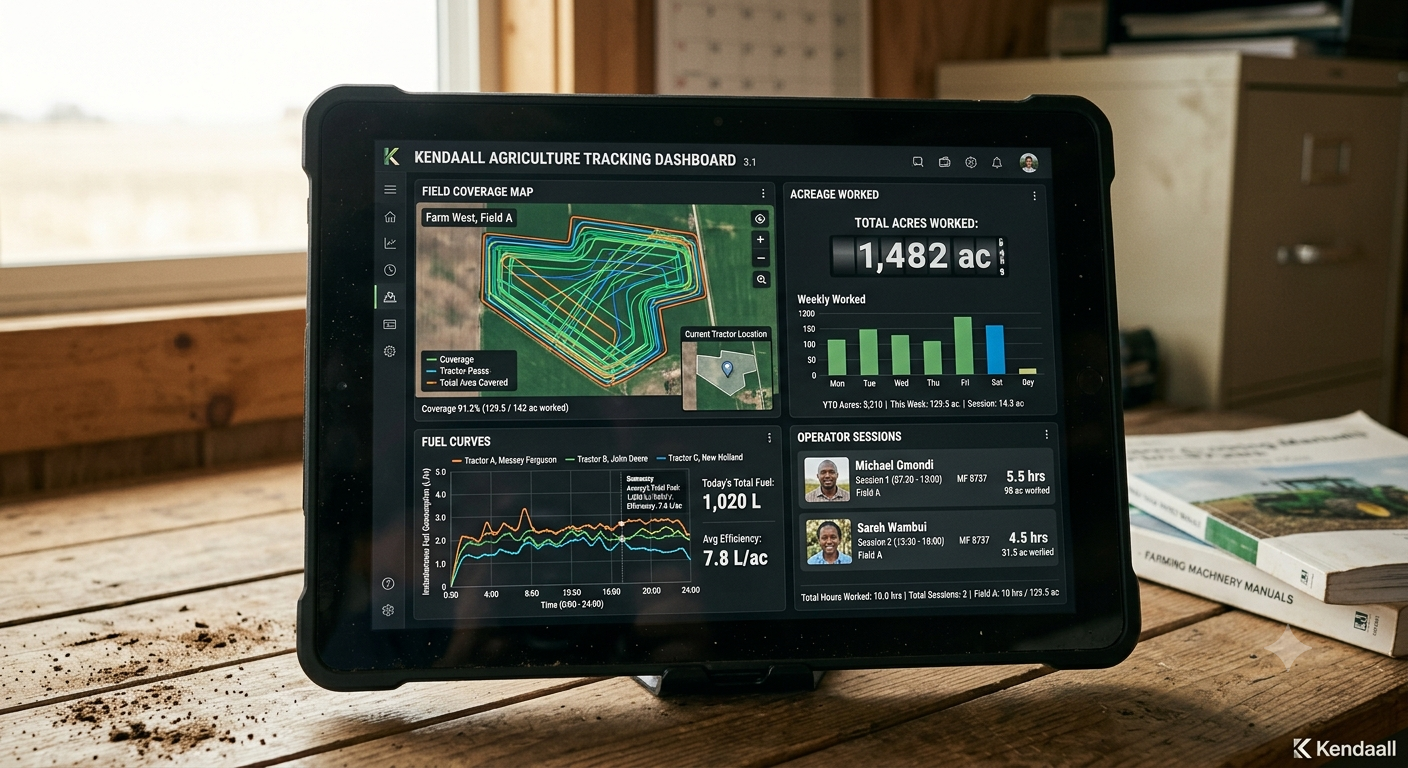
The owner’s view of the workday: coverage maps, acres, hours, fuel and who was on the seat.
What the Platform Is Installed On Across Kenyan Farms
The instrumentation is independent of a machine’s own electronics, which is the reason it fits the actual Kenyan working fleet rather than only its newest tenth. A Massey Ferguson 290 or 375 that has been ploughing since the 1990s takes the same GPS unit, ignition-hour wiring and tank sensor as a current John Deere 6110B. Below is what gets fitted, by machine class.
| Machine class | Typical examples in Kenya | Standard fitment | What it measures |
|---|---|---|---|
| Utility and field tractors | Massey Ferguson 290, 375, 385; John Deere 5045D, 5075E, 6110B; New Holland TT75, TD5; Sonalika DI 60, DI 75; Mahindra 575, Arjun; Case IH JX; Landini; Kubota M-series | GPS unit, ignition-wired hour meter, capacitive fuel sensor, RFID reader, optional CAN-bus reader | Coverage, acreage, working speed, engine hours, idle share, litres, operator |
| Combine harvesters | John Deere W-series, Case IH Axial-Flow, New Holland TC, Claas, Sampo Rosenlew | GPS unit, hour meter, fuel sensor, operator ID; CAN-bus where available | Harvest coverage per block, hours in the window, litres per acre harvested, downtime episodes |
| Self-propelled and trailed sprayers | Boom sprayers on horticulture and flower estates, Naivasha and Limuru | GPS unit, hour meter, operator ID, geofencing | Sprayed block record, pass coverage, spray-window timing, buffer-zone compliance |
| Implements and trailers | Mouldboard and disc ploughs, offset harrows, subsoilers, planters, boom sprayers, balers, farm trailers | Long-life magnetic or hard-wired asset tracker, multi-year battery | Position on schedule, movement alarms, shed-departure alerts |
| Farm transport | Canters, tippers, pickups, cane and milk haulage trucks, staff vehicles | GPS unit, fuel sensor, driver ID, optional temperature probe | Routes, stops, fuel, driver behaviour, cold-chain temperature |
| Static plant | Borehole and irrigation gensets, grain dryers, cold rooms, pump sets | Runtime sensor, fuel sensor, geofence, power-status monitoring | Runtime hours, litres burned, unauthorised movement, fuel theft from genset tanks |
Implement Width and Why the Register Matters
Acreage is a product of two numbers, and only one of them comes from the satellite. A tractor pulling a three-furrow plough at roughly 1.05 metres of effective width covers far less ground per kilometre travelled than the same tractor pulling a 2.4-metre offset harrow, and the platform cannot infer which is hitched. The implement register solves this: each implement is entered once with its working width, and a job is opened against it either by the operator on a simple in-cab selector, by the farm office when allocating work, or automatically where the implement carries its own tracker and is detected in proximity to the tractor. Farms that skip this step get accurate tracks and approximate acres; farms that maintain it get acreage figures they can invoice from.
Machines We Do Not Instrument With This Platform
Animal-drawn equipment, two-wheel walking tractors and hand-operated tools fall outside the hardware’s economics, though the asset trackers fitted to implements will watch a power tiller sitting in a store. Yield monitors, soil sensors, variable-rate controllers and auto-steer systems are a separate discipline with their own hardware ecosystem, usually built into the implement or the machine’s own terminal. The platform sits underneath that layer and complements it rather than replacing it.
How Tractor Tracking Is Used Across Kenya’s Farming Zones
The same five modules get used differently depending on the crop, the terrain and the labour model. What follows is how the platform is actually configured in each of the zones where we install most heavily.
Maize and Wheat — Uasin Gishu, Trans Nzoia, Narok, Nakuru
Large blocks, heavy tillage, compressed planting windows and a high proportion of contract ploughing make this the platform’s densest deployment area. Acreage measurement and fuel monitoring carry most of the value here: a 500-acre wheat operation in Narok burns enough diesel in land preparation alone for a five per cent measurement error to matter in absolute shillings. Combine harvesters get instrumented ahead of the harvest window specifically for the maintenance-by-hours module, because a machine down for three days in a short window costs grain quality, not just repair time. Farms around Eldoret, Moi’s Bridge, Kitale and Endebess typically run five to twenty machines on one account.
Sugarcane — Bungoma, Kakamega, Kisumu, Kwale
Cane operations are haulage-heavy as much as tillage-heavy, so the fleet is mixed from the start: tractors and trailers moving cut cane to weighbridges alongside land-prep machinery. Geofencing around the mill, the weighbridge and the zones under contract does the work here, together with trip counting and fuel per trip. Out-grower schemes use the operator ID and job-record layer to attribute machine time to individual farmer accounts, so the deduction against a grower’s payment reflects measured machine use rather than a flat rate.
Horticulture and Flowers — Naivasha, Limuru, Thika, Mount Kenya
Field machinery matters less than utility fleets, sprayers and cold chain. Spray records per block with timing and coverage support audit requirements for export markets; cold-chain transport to Jomo Kenyatta International Airport is monitored on temperature and route; estate gensets sit on the same dashboard. Flower farms also run the largest internal vehicle fleets of any agricultural operation in Kenya, which is where the fleet management layer does most of the work.
Tea — Kericho, Nandi Hills, Nyamira
Estate tea is transport-dominated: leaf collection vehicles running fixed routes between buying centres and factories on tight timing, since leaf quality degrades with delay. Route adherence, stop duration at each centre, and delivery timing to the factory are the operative measurements, with fuel monitoring on a fleet that covers high mileage on steep, punishing roads. Mechanised harvesting equipment where present is tracked on hours and utilisation.
Rice — Mwea, Ahero, Bunyala
Irrigation-scheme farming brings puddling tractors, transplanting operations and combine harvesting on small, intensively worked plots with many individual landholders sharing hired machinery. This is where per-member usage ledgers and per-plot job records matter most, because one tractor may work forty different owners’ plots in a season and every one of them needs an accurate record of what was done on their land and what they owe for it.
Ranching and Conservancy — Laikipia, Nanyuki, Machakos, Taita
Vast boundaries, thin supervision and long distances between the homestead and the working edge of the property. Boundary geofencing, water-point and borehole genset monitoring, and offline buffering for areas outside GSM coverage define this configuration. Ranches also run the longest unattended-asset windows of any client type, which makes the off-season guard module the primary reason they install rather than a secondary benefit.
Across all of them the deployment logic is the same: instrument the machine that carries the most cost and the least supervision first, prove the number, then extend the account outward to the rest of the fleet. Very few farms instrument everything on day one, and none of them need to.